
Why Pékerman?
Summer of 2006. The schools were closed. I came back to my little hometown in Bangladesh from the capital. It was the year of the World Cup. The country explodes emotionally every four years during the World Cup. We get united by the game and divided by the flags (other than our own). The whole nation, broadly speaking, gets divided in two extreme fan-bases: Argentina and Brazil.
My father was an Argentina fan, so am I. Actually, I have been one for as long as I can remember. The 2006 World Cup was very special for me. It was the last world cup my father and I would watch together.
Thankfully, we got to see how beautifully the Albiceleste played during the tournament, even though it ended bitterly. On 30 June, 2006, Argentina lost the quarter-final on penalties to Germany, the host nation and strangely what I now call home! If there was one Argentine player from that World Cup whose flashes of brilliance keeps being re-telecasted on my television of memories, it’s Juan Román Riquelme! I mean, even after all these years, I still cannot make sense of why José Pékerman decided to take off Riquelme in Berlin that day!
That was all in another lifetime. Riquelme retired from professional football some ten years ago, even long before that from the national team. Perhaps it was the experience, felt so strongly by a teenager, that these memories resurface now and then. So as a small tribute, I dig deep into my favourite player from that bunch.
From cradle of the stars
Román, as he is affectionately called by his fans, was born to a local gang member and a housewife living in San Fernando, Argentina. He was born on 24 June, 1978, the day before Argentina won their first World Cup title in home soil. Somehow his story seems tied to the Argentinian football history from the very beginning.
Román’s story is told as a typical rugged to riches, that started in Argentinos Junior’s famed academy El Semillero (the cradle of the stars). The academy recognised the talent in little Román and groomed him, as they did for one Diego Armando Maradona!
Comparison with the Argentinian God started right then and there, and it did not go away until much later. Riquelme was a mere mortal of course, but he would go on and create art in his own unique way. Riquelme’s natural position as ‘enganche’ aka the attacking midfielder, brought these comparisons, although an unfair comparison because of how different they were. Comparison to Diego is for sure a compliment, but also some sort of pressure to shine in your footballing career. The next Maradona was sold to the original’s beloved Boca Juniors for a fee of US$800,000 in 1996.
Riquelme soon reached new heights in his career with Boca. You may google yourself to find how many trophies he won during that time. But that’s really irrelevant for an artist of his nature. It was more about what he brought for the audience, a sense of footballing rhythm. If you are a romantic like me, you may compare his style with a writing poems or making music. I leave that to your imagination.
A commoner only gets to know a true great, previously unbeknownst to him, through a career defining piece of art. Journalist Joshua Law believes that Riquelme produced that piece of art in the Intercontinental cup final against the REAL MADRID (Japan, 2000). The intercontinental cup (The Club World Cup as we know it) is not something Real Madrid would be too sad about, but somehow it is given a lot of importance in Argentina (or, south America in general).
One particular moment that is etched in memories of many is the famous nutmeg to River’s Mario Yepes (2000, Copa Libertadores quarter-finals). Boca went on to win the Copa Libertadores that year.
His performances did not go unnoticed in Europe as he kept shining for Boca and La Albiceleste. When FC Barcelona came knocking at his door, he could not refuse. Just before he joined the Catalans, his brother was kidnapped and Riquelme had to bail him out. Perhaps that was an early sign for how things would turn out in Barcelona.
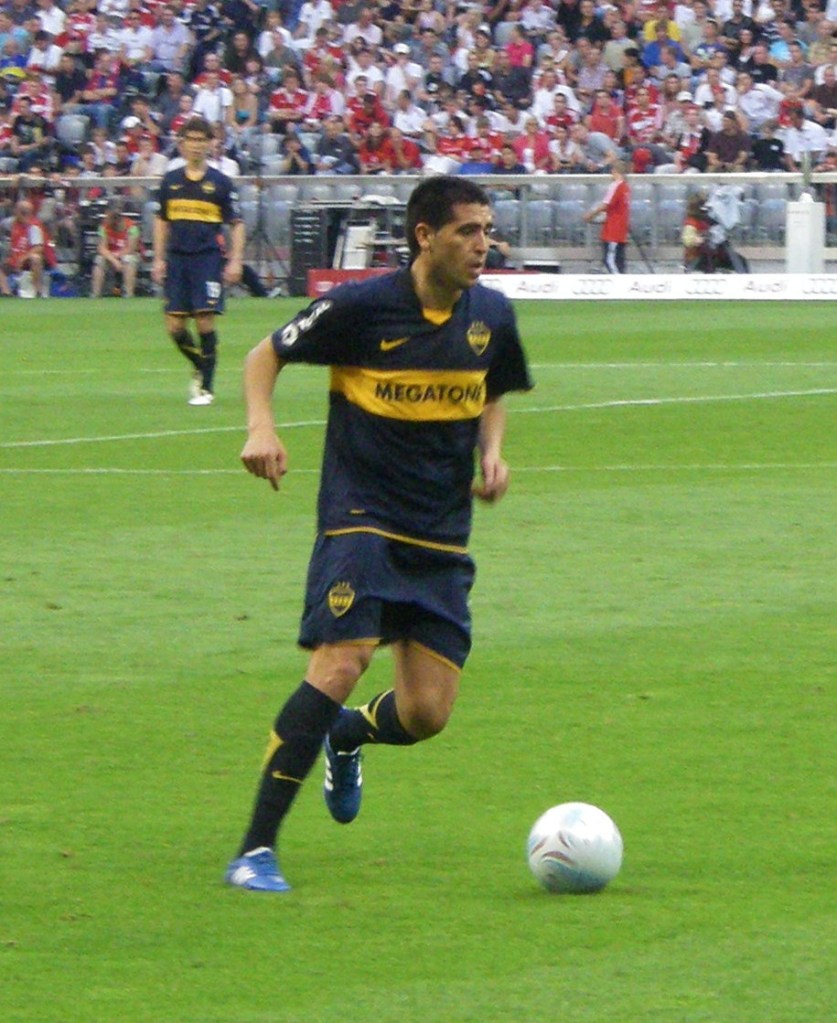
Photo: Von Chivista in der Wikipedia auf Deutsch, CC BY-SA 3.0, https://commons.wikimedia.org/w/index.php?curid=15165657
In our yellow submarine
Let us take a moment here, as Riquelme would always do on the pitch. Let us appreciate his footballing ways. Juan Román Riquelme, with the aura of a Zen master, decided solely when and where the ball was going to roll for his team. Some found him sluggish; but to others, he was playing the game at his own speed.
The Argentinian tango dancers should feel proud of Riquelme’s footwork. His passing lanes were only his to see and others to discover in awe. His freekicks are for lack of better words- poetry in motion! If seen once, can you really forget his freekick for Boca against eternal rivals River Plate? Yet with all the talents, for those who like to count goals scored and trophies won, he was not that great of a player. Why then he is seen as a cult figure beyond the Boca and Argentina fans? To answer this, we can go back to his story in Europe where his full talent was on display, albeit for a short amount of time.
From Boca, Riquelme followed Diego’s footsteps to land in FC Barcelona. Like Diego, there is nothing much to talk about his spell at Barça. Riquelme played only a season for the Blaugranas. From the onset he landed, his fall out with the then manager, Louis Van Gaal is quite well known. Perhaps it floated back to the public consciousness when Lionel Messi recreated Riquelme’s celebration in the Battle of Lusail, in front of none other than Mr. Lous Van Gaal. Although Riquelme showed a lot of respect for the Dutch coach when he said, “Van Gaal told me I was the best in the world when we had the ball and when we didn’t it was like playing with a man less. He explained to me that he hadn’t been convinced about signing me, but I learnt a lot, his training sessions were marvellous.”
Why did not he succeed? Some argue that Riquelme was a true artist, who was a misfit amidst the barrels of athletes, nor was he suitable for a rigid authoritarian structure. He needed a certain degrees of freedom to flourish, unfortunately not many clubs can give that. Villarreal as a medium sized club could provide just that after Riquelme was ousted by FC Barcelona.
When the Yellow Submarine onboarded the genius, his true potential was unleased. With coaching from Manuel Pellegrini, and teammates like Diego Forlan, Santi Cazorla, and Marcos Senna, the Villarreal has a great run in the La Liga that year (2003) and in the Champions League the next year! It was Villarreal’s best run so far on the highest of European competitions. He is still cherished by Villarreal fans; he is a legend for the Yellow Submarine.
After 3.5 years in Villarreal, things again turned out to be chaotic for Riquelme. His way of being clashed with how Villarreal management wanted to run the club. He was loaned to Boca for half a season in the beginning, but a permanent deal followed soon after. He came back to Boca permanently later. Riquelme played for Boca until 2014. During this second spell, he cemented his legendary status for the club, performed arts every week and won some trophies (if you are into that).
Even though he played in Boca and is a bigger legend than even Maradona there, he is respected by even the River fans. That’s saying something about him.
Back to the cradle
Like a good story, the ending is connected through a string to the beginning. Román’s footballing journey would finish for the Juniors in the second tier of Argentine football. It’s text book staff for a football romantic. Sometimes I think to myself, wound not it be nice if Riquelme was playing now. Sure, I agree, football has changed a lot. It is now played at a disturbingly high speed, perhaps fitting to the restlessness and hunger for dopamine of our time. People would still declare him unfit, slow and all. But I have a feeling that even then, if you look closely, he would see nothing but magic.
Riquelme is the president of Boca Juniors now and has recently become the vice president of AFA. And, I spend a few minutes each day (mostly) watching Riquelme’s match highlights on YouTube and Instagram.
To end the first post on this website, I just want to say, thank you, Román.
By the way, if you are into seeing Riquelme magic in action, I can suggest riquelmefutbol10 on Instagram. Enjoy!
Resources-
- The Last of His Kind | Juan Roman Riquelme, The Football History Boys, 2024.
- A forensic analysis of Juan Roman Riquelme’s magnum opus v Real, Joshua Law, Planetfootball.com, 2023.
- Adiós Juan Román Riquelme, the iconic No10 who played by his own code, Marcela Mora y Araujo, The Guardian, 2015.
- Farewell to Juan Roman Riquelme: Rebel witha pause, Gary Thacker, Allbluedaze.com, 2015.
- Juan Román Riquelme – bio and football career, Footballhistory.org.
- The Last of the Mohicans: Juan Román Riquelme has his own fan base of writers.
- El último mohicano: Juan Román Riquelme tiene su propia hinchada de escritores, Daniel Gigena, La Nacion, 2023.
- JUAN ROMÁN RIQUELME, MARIO YEPES AND THE GREATEST NUTMEG EVER, Dan Williamson, thesefootballtimes.co, 2019.
- Juan Román Riquelme: A true rags-to-riches story, Villarreal CF, 2019.
- JUAN ROMAN RIQUELME: AN ARTIST IMPRISONED IN A WORLD OF ATHLETES, Euro Sport, 2015.
- JUAN ROMÁN RIQUELME: THE DREAM COMES FIRST, Omar Saleem, thesefootballtimes.co, 2018.
- Juan Román Riquelme: The Story Of The No.10, La Liga Lowdown (Podcast), 2020.
- Portrait of an icon: Juan Roman Riquelme, Daniel Storey, Football365.com, 2016.
- Juan Román Riquelme, Wikipedia.
Header image: Conceptual illustration created using AI tools with guidance from ChatGPT
Bonus
My favourite quotes on Riquelme:
“If we have to travel from point A to point B, everyone would take the six-lane highway and get there as quickly as possible. Everyone, except Riquelme. He would choose the winding mountain road, that takes six hours, but that fills your eyes with scenes of beautiful landscapes” – Jorge Valdano (Argentine former player and coach).
“The space given to fantasy and beauty is increasingly reduced,…But that beauty is what makes football unique and that is why different players will never become extinct. Football will not lose the beauty that distinguishes it even if the playmaker ceases to exist and Riquelme, as the last exponent of that type of player, the last Mohican, unfortunately retires one day.”- Eduardo Galeano (Writer).
“He is one of the few players that always put the ball where it should go.”- Luis Aragonés (Spanish football player and manager).

 Albiceleste Stories
Leave a comment